Under the Umbrella: Light Pollution & The Ohio Night Sky
Thank you to Melissa Barrington and the team at WDTN for showcasing the importance of dark skies!
Transcript
Melissa: Well, hello and welcome to this edition of Under the Umbrella. I’m a WDTN meteorologist, and today we’re going to be talking about a couple of different topics regarding the sky: light pollution and the Ohio night sky. It’s also National Astronomy Month. Today we have with us Jack Bernstein, Vice President of the Miami Valley Astronomical Society, and Elizabeth Schumacher-Berger, Secretary of the same organization. Thank you both for joining us.
Jack & Elizabeth: You’re welcome. Thank you for having us.
Melissa: So I want to start with the fact that it’s International Dark Sky Week during the month of April, and it’s also Astronomy Month for the entire month of April. Can you first tell us a little bit about what light pollution is?
Elizabeth: Absolutely. Light pollution is essentially the environmental impact of artificial lighting. It impacts the environment in multiple ways. It impacts wildlife; insects are drawn to light, so they become easier targets of prey, which results in species loss. Fireflies, for example, use their light to attract mates, and with artificial lighting, they can’t do that effectively.
It also impacts human health in ways we’re just now discovering. Blue light actually stops our production of melatonin. A lot of the LED street lights installed in cities emit blue light, which disrupts sleep. Studies have shown that this circadian rhythm disruption can increase the risk of certain hormonal-related cancers like prostate and breast cancer, and conditions like diabetes.
A lot of people don’t really know about it because they grow up in the city and think that’s just what the night is supposed to look like. If they don’t have the opportunity to travel, they don’t realize what the night sky actually looks like.
Melissa: Jack, you were showing a particular website. What were we looking at?
Jack: That was lightpollutionmap.info. What you’re looking at is gradations of brightness. The pin shown is downtown Dayton, and it is very bright. In downtown Dayton, it’s impossible to see the Milky Way. I live up in Englewood, and even there I cannot see the Milky Way. You’d have to go somewhere much darker. You can see some stars and constellations, certainly Orion, but once you’re in the city, it gets very difficult.
Melissa: I’d imagine the air mass also plays a role, whether it’s cold or humid outside?
Jack: That’s called transparency, and you’re absolutely correct. If it’s a really humid day, it’s not very transparent. If it’s a cold, clear day in the middle of winter, you can see a lot. This past winter we had lots of snow and clouds, and on the really clear days it was 20 below zero, so I wasn’t going out!
Melissa: Why should people be aware of light pollution? I’m almost comparing it to the urban heat island effect in weather.
Elizabeth: People should care because it has a significant impact on our natural ecosystem. We do need a day and a night cycle. For example, there are nocturnal pollinators that pollinate specific plant; if they’re distracted by light, they’re not doing their job, which then impacts plant health.
A common pushback I get on light pollution is the issue of safety and crime. A lot of people say, “I need light to be safe.” But that’s a misconception; light makes us feel safer, but there have been no studies showing a clear correlation between brightly lit areas and crime reduction. In fact, some park naturalists at Ohio state parks have noted that if they leave their lights on, people are actually more likely to loiter, because they can see and it doesn’t feel dark or creepy.
Melissa: What does light pollution do for bird migrations?
Elizabeth: It really disrupts them. Birds use the moon and stars to navigate, so they’re very distracted by artificial lighting. If there’s a brightly lit building, they’ll go off course and circle it repeatedly until they either fly into a window or fall from exhaustion.
There’s a great resource for people who want to learn more, an organization called Ohio Lights Out that partners with groups to raise awareness about how light pollution impacts migratory birds. This is actually a good time to mention it because World Migratory Bird Day is May 9, and birds are migrating right now with the peak expected in May.
Melissa: Does that cause a change in the types of species we see in Ohio?
Elizabeth: Honestly, I’m not really sure. The park naturalists and folks from Ohio Lights Out would know more about that.
Jack: I’m not sure either. That’s a great question for the experts there.
Melissa: Jack, you mentioned another aspect of light direction as well?
Jack: Yes. Think about globe lights, for instance. They send light upward, downward, and sideways. If you want to light up a pathway, use a downlight. Directing your lights is a big part of addressing light pollution. Also, LED lights are full spectrum, like sunlight, and for me as an astrophotographer, shooting with LED lights is very difficult because I can’t filter out those frequencies. If you had red lights, as often used in darkrooms, that’s not a problem for night vision or astronomy.
Elizabeth: Ideally, we look at color temperature, lights around 2,700 Kelvin have less of an environmental impact. Unfortunately, many cities are switching to white full-spectrum LEDs because they’re cheaper and energy-efficient, but those emit a lot of blue light. Cities can at least install shields; I know AES Ohio and Miami Valley Lighting both offer them, called “night guards,” which direct light downward and prevent what we call sky glow and light trespass.
Sky glow is that purple haze you see hovering over a city. Light trespass is when a street light shines into someone’s home rather than just onto the street; it’s not hitting its intended target.
Melissa: Can you explain the Bortle Scale for us? Because people may not realize what they’re missing.
Elizabeth: Sure! The Bortle Scale is a system founded by astronomer John Bortle. It’s based on how many stars you can see in the sky. The lower the number, the more stars you can see and the less light pollution there is. Out west, you might be in a Bortle 1 or 2 area. Five to six is typical for a rural area just outside a city, places like John Bryan State Park or Caesar Creek State Park might be in that range. I took a photo from my front yard in West Carrollton, and at that light pollution level, I can barely see much, just the moon when it’s out.
I also brought a more scientific tool, a sky quality meter. It has a sensor and you point it straight up at the zenith. The scale works opposite from the Bortle Scale: a lower number means more light pollution, and a higher number means less. It basically measures the brightness of the sky.
Melissa: What do you use it for besides general knowledge?
Elizabeth: There’s an organization called Globe at Night that runs citizen science campaigns where you observe one constellation for a period of time, take sky quality meter readings, and submit the data. They use it to build light pollution maps and identify which areas are most affected. It’s also required data if a location wants to become DarkSky-Certified. You need about a year’s worth of readings to show you’re actively preserving darkness.
Melissa: Welcome back! Jack, the Bortle Scale really affects your astrophotography, right?
Jack: Absolutely. I live in Englewood, Bortle 6, so I can get some unfiltered pictures, but if the moon is up or it’s more polluted, I have to use filters in my cameras, which means I’m only capturing certain wavelengths like hydrogen, sulfur, and oxygen. It’s a pretty picture, but it’s not natural. In a really dark sky, you can get a beautiful, natural image of everything.
Ohio is quite bright overall. If you want truly dark skies, you need to go far out west or find specific spots on the east coast, northern Pennsylvania or the mountains of West Virginia. When people say there’s a “dark sky site in Ohio,” it’s a relatively dark site. Nothing like what you’ll see out west.
My best example: Years ago we were in the Nevada desert. My wife and I got out with the kids, looked up, and said, “Oh, it’s cloudy.” It wasn’t. It was the Milky Way. That’s what Bortle 1 looks like.
Melissa: Are there any dark sky preserves in Ohio?
Elizabeth: There aren’t any official preserves yet, but there are a couple of notable locations, Geauga Observatory Park in Northeast Ohio and Fry Family Park. John Glenn Observatory at Hocking Hills is also popular, though it’s not technically DarkSky-certified.
The good news is that DarkSky Ohio, which I’m also part of, is working with ODNR’s Parks & Watercraft Division. Several state parks are pursuing DarkSky ertification: Caesar Creek is already in that process, and Hocking Hills, Lake Hope, Shawnee, and John Bryan are all starting the process. Hopefully there will be more beautiful night skies for Ohioans soon. But in the meantime, the biggest thing is just to get as far from city lights as possible.
Melissa: What should we be looking at in the spring night sky?
Jack: We’re at the end of winter sky season. If you look west in the evening, Orion is still there, but it’ll be gone very soon. We’re entering what’s called galaxy season; lots of small galaxies visible in the sky, though even with binoculars, they can be tricky to find.
Andromeda is the largest galaxy visible to the naked eye, but it’s more of a fall target. Many of these galaxies and nebulae are enormous. Andromeda is five times the size of the full moon, but they’re dim. You need wide-angle lenses and several minutes of exposure to capture them properly. To the naked eye, you mostly see a faint fuzzy patch.
[Discussing astrophotography images] Here’s a comet photographed from Centennial Park in Englewood taken with an iPhone with a 3-second exposure. And we’ve been having quite a few comets recently.
Melissa: Speaking of which, wasn’t there something over Cleveland recently?
Jack: That was a bolide, a large meteor that broke apart and streaked across northeast Ohio. Lots of people are searching for it now.
We also had the solar eclipse two years ago, which was absolutely gorgeous. And there was a lunar eclipse recently on March 13th, but unfortunately clouds and rain blocked the view here.
For the near term: the moon just passed new, so a full moon is coming. When the moon is not full, you get beautiful shadows and crater details; it’s a fantastic binoculars target. A full moon is bright and beautiful, but lacks contrast. The crescent moon, just after new moon in the evening, or just before new moon in the morning, is particularly stunning.
Melissa: What else is coming up in mid-to-late spring?
Jack: There’s a minor meteor shower in the middle of this month called the Lyrids, from the constellation Lyra. You look up toward midnight and watch for shooting stars radiating outward from the radiant point in that constellation. The better meteor showers are the Perseids in late summer, but we can discuss those another time.
With meteor showers, you want a dark moon phase and to get away from city lights. From West Carrollton you might see zero meteors an hour, but go to a dark site and you’ll see them in abundance.
Melissa: Thank you both very much. I think we could do an entire episode on both of these topics, and we may have to have you back. Thank you for joining us today on this edition of Under the Umbrella, and thank you for watching. Until next time, have a great night!
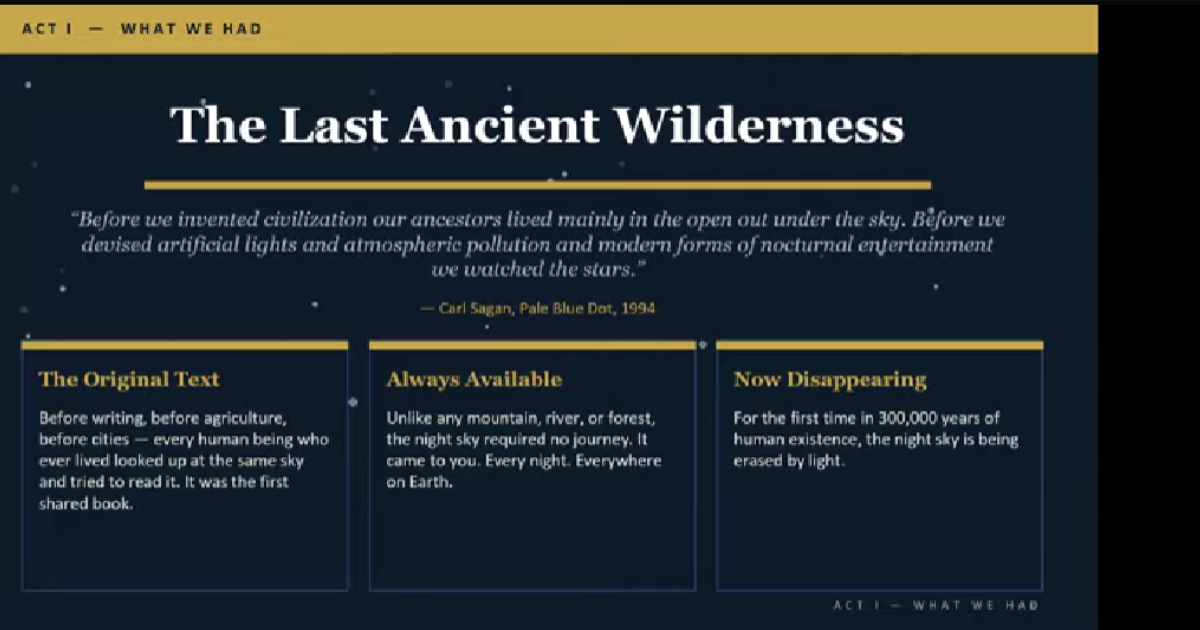
Philip Hutchison, Historical Program Administrator with ODNR, discusses the cultural and spiritual significance of the night sky and why reducing light pollution is a matter of historical and cultural preservation.
Brad Kerry, Director of Government Affairs with DarkSky Ohio, discusses how to approach your city council to develop or update a lighting ordinance.
Be Part of the Dark Sky Movement
Light pollution is the only environmental problem that can be easily resolved. Whether you volunteer, talk to your neighbors, or donate, every action matters.
DarkSky Ohio is a chapter of DarkSky International, a 501c(3) nonprofit committed to preserving night skies. Our chapter works to reduce light pollution and conserve Ohio's ecosystems by educating communities on the importance of responsible lighting.